


Honor 600
Updated: Jul 8
SMARTPHONE TIER: HIGH TIER
Battery Capacity mAh: 6400
Honor 600 : The Closest Thing to an Android iPhone
SMARTPHONE BATTERY PERFORMANCE
Based on Price: High Tier (€500-€699)
High Tier Ranking #2
Learn more:
Video Review - Soon Available
The Honor 600 is an upper mid-range smartphone designed to offer a premium-feeling experience without moving fully into flagship pricing territory. Rather than relying solely on raw performance, Honor focuses on display quality, battery endurance, AI-assisted software features, photography, and long-term usability. The result is a device that feels ambitious for its category, appealing to users who want a modern design, a bright screen, strong autonomy, and extended software support at a more accessible price point.
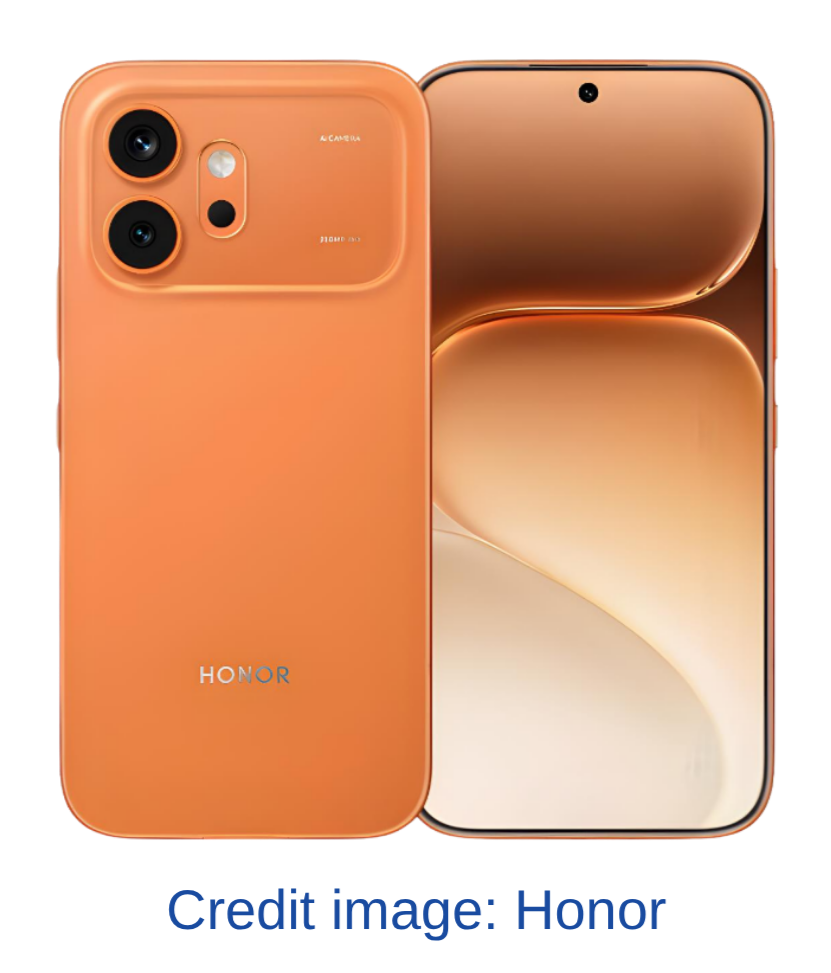
In terms of design, the Honor 600 adopts a noticeably premium aesthetic, though its inspiration is difficult to ignore. With its flat edges, large rectangular camera island, additional side button and orange colour option, it clearly echoes the visual language of recent iPhone Pro models. Even so, the execution is polished. The phone feels slim, compact and comfortable in the hand, measuring approximately 156 millimetres in height, 74.7 millimetres in width and 7.8 millimetres in thickness, with a weight of around 185 grams. This makes it easier to handle than many large mid-range devices, while still offering a generous screen size.
The front is dominated by a 6.57-inch AMOLED display with a resolution of 2728 by 1264 pixels, resulting in a sharp pixel density of around 458 pixels per inch. The panel supports a 120 Hz refresh rate, making everyday navigation, scrolling and animations feel smooth and responsive. One of the display’s strongest characteristics is its very high brightness, with Honor advertising a peak of up to 8000 nits in specific HDR conditions. Real-world measurements vary depending on the test method, but reviewers consistently highlight the screen as extremely bright and easy to read outdoors. The ultra-thin bezels also help give the device a more premium appearance than its price might suggest.
Durability has also improved compared with many conventional mid-range smartphones. The Honor 600 carries IP68, IP69 and IP69K certifications, giving it strong resistance against dust, immersion and high-pressure water jets. This makes it more reassuring for everyday use, whether exposed to rain, accidental splashes or dusty environments. The rear panel uses a lightweight composite material rather than glass, which helps keep the weight under control while still offering a smooth, refined finish. The metal frame further contributes to the phone’s solid in-hand feel.
Performance is handled by Qualcomm’s Snapdragon 7 Gen 4 chipset, built for efficient upper mid-range devices. In everyday use, the Honor 600 feels fast and responsive, handling web browsing, messaging, streaming, social media, navigation and multitasking without difficulty. It is not intended to compete directly with flagship chipsets, but it delivers more than enough power for most users. Gaming performance is also solid, with demanding titles running well at sensible settings. However, several tests note that the phone can heat up during longer gaming sessions or heavy workloads, so it is better suited to regular gaming than sustained high-performance play.
Photography is another key part of the Honor 600’s appeal. The rear camera system is led by a 200-megapixel main sensor with an f/1.9 aperture and optical image stabilisation. In good lighting, this camera produces detailed, bright and visually pleasing images, with strong sharpness in the centre and a slightly enhanced colour profile that works well for social media. The high-resolution sensor also allows the phone to offer convincing 2x and usable 4x digital zoom through cropping, although it cannot fully replace a dedicated telephoto lens.
The lack of optical zoom remains one of the phone’s main photographic limitations. Beyond 4x, image quality becomes more dependent on software processing, with detail loss and visible reconstruction. The 12-megapixel ultra-wide camera adds flexibility for landscapes, architecture and group shots, but it is clearly weaker than the main sensor. It performs adequately in daylight, but detail, sharpness and low-light performance are more limited. On the front, the 50-megapixel selfie camera produces sharp and well-exposed images, making the Honor 600 a strong option for users who frequently take portraits, selfies or social media content.
Video recording is also competitive for the segment, with support for up to 4K at 30 frames per second on both the rear and front cameras. Stabilisation and dynamic range are generally good, making the device suitable for casual video capture, vlogging-style clips and social media use. Honor’s AI tools further expand the creative possibilities, particularly with image editing, object removal, portrait enhancements and image-to-video generation. Some of these features rely on cloud processing, which may not appeal to every user, but they do help the device feel current and feature-rich.
Battery life is one of the Honor 600’s strongest areas. In Europe, the device is equipped with a 6400 mAh silicon-carbon battery, which is unusually large for a phone that remains only 7.8 millimetres thick and weighs 185 grams. In our viSer battery testing, the Honor 600 achieved 53 hours of use, ahead of the Xiaomi 15T at 44 hours, the Xiaomi 14T at 39 hours and the High Tier average of 46 hours. This translates to around two days of use, compared with 1.5 days for both Xiaomi models and 1.75 days for the High Tier benchmark.
Annual energy consumption is also well controlled. The Honor 600 recorded 3.9 kWh, which is slightly above the High Tier average of 3.79 kWh, but lower than the Xiaomi 15T at 4.0 kWh and the Xiaomi 14T at 4.2 kWh. This shows that the phone manages to deliver longer battery life without becoming inefficient in terms of yearly energy use. Its Battery Performance Score of 49 out of 100 also places it ahead of the Xiaomi 15T, Xiaomi 14T and the High Tier average in this comparison.
Charging is handled via cable, with support for up to 80 W fast charging. With a compatible charger, the phone can be recharged fully in around 50 to 60 minutes depending on the testing conditions. This is a strong result given the large battery capacity. Wireless charging is not included, which is understandable for the segment but still worth noting. The device also supports wired reverse charging, allowing it to top up accessories such as earbuds or another phone in an emergency.
Connectivity is comprehensive for a modern mid-range smartphone. The Honor 600 supports 5G, dual SIM with eSIM compatibility, Wi-Fi, Bluetooth 5.4, NFC and USB-C. Some markets and sources list Wi-Fi 6, while others mention Wi-Fi 7 support, so availability may vary depending on region or configuration. Biometric security is handled through an under-display fingerprint sensor and facial recognition, both of which add convenience for everyday unlocking. Audio is delivered through stereo speakers, which are suitable for videos, calls and casual listening, though they do not replace dedicated headphones or external speakers for richer sound.
On the software side, the Honor 600 ships with MagicOS 10 based on Android 16. The interface continues Honor’s familiar blend of Android functionality with iOS-inspired visual elements, including transparent effects, a Dynamic Island-like notification area and a strong focus on ecosystem integration. One of the more interesting additions is improved compatibility with Apple devices, including easier file transfers and screen-sharing features through Honor’s ecosystem tools. This makes the Honor 600 particularly unusual among Android phones, as it actively tries to appeal to users who may also own a Mac or iPhone.
AI features are central to the software experience. The Honor 600 includes tools for AI photo editing, AI writing, summaries, translation, voice-related features, deepfake detection and image-to-video creation. While not every feature will be essential to every user, the overall package feels modern and ambitious. The main drawback is the presence of preinstalled apps and software clutter at first launch. These can be removed, but they slightly weaken the otherwise polished impression. More positively, Honor promises six years of Android version updates and security patches, which places the Honor 600 among the best-supported smartphones in its price range.
Overall, the Honor 600 is a very strong upper mid-range smartphone that focuses on the areas that matter most to everyday users. Its design may be heavily inspired by Apple, but the phone stands on its own thanks to its excellent display, compact build, strong durability, capable main camera, generous software support and outstanding battery life. It does not offer wireless charging, a true telephoto lens or a completely clean software experience, and it can warm up under heavy gaming loads. However, these compromises are balanced by a package that feels refined, practical and highly competitive.
For users looking for a modern Android smartphone with a premium look, long battery life, a bright AMOLED display, useful AI features and six years of updates, the Honor 600 is a compelling choice. It may borrow some design cues from flagship rivals, but its real strength lies in delivering a reliable, long-lasting and well-rounded experience at a far more accessible price.
Pros | Cons |
|
|
|
|
|
|
|
|
|
|
|
|
|
|
|
|
|
|
|
|
|
|
|
|
|
|
|
ViserMark Labels for the Honor 600
Please take a look at the following information about the battery performance of the Honor 600:

Battery Life: The Honor 600 delivers excellent real-world endurance, achieving up to 53 hours of active use in SmartViser testing. This translates to approximately two full days of use under balanced conditions, placing it ahead of the Xiaomi 15T, which reached 44 hours, the Xiaomi 14T, which reached 39 hours, and the High Tier average of 46 hours. Despite its bright 6.57-inch AMOLED display, 120Hz refresh rate and slim 7.8mm body, the Honor 600 manages to provide consistently strong runtime thanks to its large 6400mAh silicon-carbon battery and effective system optimisation. For users who prioritise long battery life without needing to constantly monitor their usage, the Honor 600 stands out as a highly dependable option in its segment.
Battery Charging: Charging performance is another strong point for the Honor 600. The device supports 80-watt wired fast charging, allowing the large 6400mAh battery to recharge fully in around 50 to 60 minutes with a compatible power adapter. This is particularly impressive given the size of the battery and reinforces the phone’s positioning as a practical daily device for heavy users. The Honor 600 also supports 27-watt wired reverse charging, making it possible to top up accessories such as earbuds or another smartphone when needed. However, there is no wireless charging, which remains one of the main compromises compared with some premium competitors. As with many recent smartphones, users may also need to provide their own compatible charger to reach the fastest charging speeds.
Battery Performance & Efficiency: The Honor 600 performs strongly in SmartViser’s task-based battery testing, showing a well-balanced profile across real-world usage scenarios such as social media, calls, gaming, downloads and uploads, camera use, YouTube, replay, media playback and web browsing. The device achieved a Battery Performance Score of 49 out of 100, outperforming the Xiaomi 15T at 43, the Xiaomi 14T at 45, and the High Tier average of 45.5. Annual energy consumption was measured at 3.9 kWh, slightly above the High Tier reference value of 3.79 kWh, but still lower than the Xiaomi 15T at 4.0 kWh and the Xiaomi 14T at 4.2 kWh. This shows that the Honor 600 combines longer battery life with controlled energy consumption. While its battery efficiency score of 1 leaf out of 5 is not exceptional, it remains competitive with the Xiaomi 14T and the High Tier average, and ahead of the Xiaomi 15T. Overall, the Honor 600 demonstrates strong hardware-software optimisation, delivering extended usage times and a solid energy profile for an upper mid-range smartphone.
Specification Overview - Released Date: May 2026
Body & Build:
Dimensions: 156 × 74.7 × 7.8 mm
Weight: 185g
Materials: Glass front, composite rear panel, metal frame
Durability: IP68, IP69 and IP69K water and dust resistance; SGS 5-star drop-resistance certification highlighted by Honor.
Design: Slim, flat-edged design with a compact footprint and a premium-leaning finish. The large rectangular camera module and additional side button give it a very iPhone-inspired look, especially in the orange colourway, but the build remains refined, lightweight and comfortable in hand.
Display:
Size: 6.57-inch AMOLED
Resolution: 2728 × 1264 pixels, around 458 ppi
Refresh Rate: Up to 120Hz
Brightness: Up to 8000 nits peak brightness in specific conditions.
HDR Support: HDR video playback supported
Protection: Strengthened front glass; manufacturer-rated durability, but no Gorilla Glass branding specified
Display Features: Ultra-thin bezels, 1.07 billion colours, high-frequency PWM dimming, eye-comfort features and strong outdoor visibility.
Operating System:
OS: Android 16 with MagicOS 10.
Support: 6 years of Android OS updates and security patches, according to Honor’s product positioning for the series.
Chipset & Performance:
Global Variant:
Processor: Qualcomm Snapdragon 7 Gen 4
CPU: Octa-core (1× Cortex-A715 + 3× Cortex-A715 + 4× Cortex-A510 configuration)
GPU: Adreno GPU
Memory & Storage:
Configurations:
8GB + 256GB
8GB + 512GB
Expandable Storage: Not supported
Storage Tech: UFS storage, generation not officially specified
Connectivity & Features:
Network: GSM / HSPA / LTE / 5G
SIM: Dual SIM, with eSIM support depending on market
Wi-Fi: Wi-Fi 6
Bluetooth: Bluetooth 5.4
NFC: Available, market-dependent
Infrared Blaster: Yes
USB-C: USB Type-C, likely USB 2.0 based on regional specifications and review testing
Biometrics: Under-display fingerprint sensor and facial recognition
Other Features: AI Photography, AI Image to Video 2.0, Magic Portal, Magic Capsule, Circle to Search, AI translation, AI transcription, AI Deepfake Detection, AI Voice Cloning Detection and cross-device connectivity with iPhone, Mac and Windows PCs.
Audio:
Speakers: Stereo speakers
3.5mm Jack: Not included
Audio Features: HONOR sound enhancements, with general stereo playback suitable for streaming, calls and casual media use.
Camera System:
Rear Cameras:
200MP main camera, f/1.9, OIS, AF, 1/1.4-inch sensor
12MP ultra-wide camera, AF
Video: Up to 4K at 30fps on the rear camera system
Front Camera: 50MP portrait selfie camera
Front Video: Up to 4K at 30fps
Colours Available: Orange, Black and Golden White.
Performance - HOW WE TEST
ViserMark offers a comprehensive range of battery performance test results based on different criteria and benchmarks for evaluating a smartphone's performance. Our tests are performed using the strictest protocol in a controlled environment to ensure repetition and consistency powered by SmartViser's test automation solution viSer.

VWS Analytics Studio is a complementary product to the viSer Test Automation solution. It enhances the viSer user experience and is the fastest way to analyse and view smartphone test results.
We have used the interactive dashboard to show you the recent test results and translated them into ViserMark Labels.
Join our readers to receive the latest update to our smartphone battery performance scores and performance reviews as soon as we finish testing!

Smartphone Battery Performance - FULL TEST RESULTS AND REVIEW
ViserMark has put the Honor 600 through our testing protocol, based on real smartphone usage from 100% battery level down to power off. This includes daily activities, such as calls, web, video and music streaming, gaming, social networks, picture and video capture, and standby. All activities are executed in a defined order and timeline.
These test results, show how the Honor 600 performed and the scores achieved.
1. Battery Performance
The Honor 600 achieved a battery performance score of 49/100, placing it above the High Tier average of 45.5/100 and ahead of both the Xiaomi 15T (43/100) and the Xiaomi 14T (45/100). This result positions the Honor 600 as a strong battery performer within Visermark’s High Tier category, showing that its large 6400mAh silicon-carbon battery is well supported by effective power management and system optimisation. While its efficiency score is not the highest in the segment, the device delivers a consistently strong real-world battery profile, particularly in terms of total runtime and day-to-day reliability.

Charging is handled through 80W wired fast charging, allowing the Honor 600 to recover from empty to full in around 50 to 60 minutes with a compatible charger. This is a practical result given the size of the battery and helps reinforce the phone’s suitability for heavy daily use. As with many recent smartphones, the charger may not be included in the box, meaning users will need a suitable power adapter to reach the maximum charging speed. Wireless charging is not supported, but the Honor 600 does offer 27W wired reverse charging, allowing it to top up accessories or another device when needed.

Overall, the Honor 600 demonstrates a convincing energy-to-performance balance within the High Tier segment. For everyday users, the Honor 600 offers a strong combination of long runtime, fast wired charging and controlled energy consumption, making it one of the more dependable battery performers in its category.
2. Battery Life
In ViserMark’s battery life testing, the Honor 600 delivered up to 53 hours of active usage, corresponding to approximately 2 full days of typical real-world use. This result places it clearly above the High Tier average, which stands at around 46 hours or 1.75 days, and ahead of both the Xiaomi 15T, which achieved 44 hours or 1.5 days, and the Xiaomi 14T, which reached 39 hours or 1.5 days.

This strong endurance is particularly notable given the Honor 600’s positioning in the High Tier segment, where devices often combine bright displays, powerful chipsets and demanding feature sets. Despite its 6.57-inch AMOLED display, 120Hz refresh rate and slim design, the Honor 600 manages to deliver longer runtime than the category reference. Its 6400mAh silicon-carbon battery, combined with system-level optimisation and the efficiency of the Snapdragon 7 Gen 4 platform, helps the device convert its battery capacity into extended real-world usage.

When compared directly with its closest competitors, the Honor 600 maintains a clear advantage. The Xiaomi 15T falls 9 hours behind, while the Xiaomi 14T trails by 14 hours. The Honor 600 also exceeds the High Tier average by 7 hours, showing that it is not only competitive against individual rivals but also stronger than the broader category benchmark. This suggests that the Honor 600 is particularly well suited to users who need reliable all-day endurance with enough capacity to comfortably stretch into a second day.

The Honor 600 and Xiaomi 14T were analysed for battery consumption across a wide range of everyday tasks using SmartViser's viSer and VWS Analytics Studio. The comparison highlighted differences in power usage for activities such as social media, calls, gaming, camera, and web browsing.
During social media usage, the Honor 600 draws slightly more power than the Xiaomi 14T, indicating higher consumption during continuous scrolling and screen-on activity. However, the difference remains relatively moderate and does not prevent the Honor 600 from achieving stronger overall battery life.
In outgoing voice calls, the Honor 600 also consumes slightly more power than the Xiaomi 14T. This suggests that Xiaomi’s device is somewhat more efficient during sustained voice communication. Even so, the gap is not large enough to outweigh the Honor 600’s broader endurance advantage.
For gaming, the Honor 600 shows higher current consumption than the Xiaomi 14T. This is expected given the demands placed on the chipset, display and thermal system during extended gameplay. While the Xiaomi 14T appears more efficient in this specific scenario, the Honor 600 still delivers a stronger total runtime overall, helped by its larger battery and balanced optimisation.
The Honor 600 performs less efficiently in download and upload tasks, drawing more power than the Xiaomi 14T during data-intensive activity. This indicates that the Xiaomi 14T manages network-related workloads more economically in this part of the test.
Camera usage is one of the areas where the Honor 600 performs more efficiently than the Xiaomi 14T. During extended camera activity, the Xiaomi 14T draws noticeably more power, reflecting the heavier energy demands of its imaging system and processing pipeline. The Honor 600 manages camera-related workloads more effectively, which helps preserve battery life during photography and video capture sessions.
During YouTube streaming, however, the situation is reversed. The Honor 600 consumes more power than the Xiaomi 14T, indicating that Xiaomi’s device is better optimised for long-form video streaming workloads. A similar pattern appears during video replay, where the Honor 600 again draws noticeably more power.
In media playback, both devices perform at a very similar level, with near-identical power consumption. This suggests comparable efficiency during audio-focused tasks such as music playback or background media listening.
For web browsing, the Xiaomi 14T once again demonstrates lower power consumption. The Honor 600 draws more energy during continuous browsing sessions, likely due to its display behaviour and overall system tuning under active screen-on workloads.

Overall, the Honor 600 exhibits a more performance-oriented battery profile, consuming more power in several demanding screen-intensive scenarios such as gaming, streaming and web browsing. However, it also demonstrates stronger optimisation in camera-related tasks and compensates for its higher consumption with a significantly larger 6400mAh silicon-carbon battery. This allows the device to achieve longer overall battery life despite drawing more power in certain workloads. The Xiaomi 14T, by contrast, relies on lower consumption across several everyday tasks to maintain efficiency, but ultimately falls behind in total runtime.
When comparing the Honor 600 with the Xiaomi 15T across SmartViser’s battery consumption tests, the differences in optimisation become immediately clear. Although both devices occupy the same high-tier category, their behaviour under everyday workloads reflects two distinct energy-management approaches.

In lighter everyday tasks such as social media, browsing, and calls, the gap remains relatively moderate, showing that both devices maintain broadly competitive efficiency levels during standard smartphone use. Gaming and download/upload workloads also favour the Xiaomi 15T, which draws less power under sustained processing and connectivity demands.
The most significant difference appears during video replay, where the Honor 600 consumes substantially more power than the Xiaomi 15T. This indicates a clear efficiency advantage for Xiaomi during local video playback and prolonged display-driven media consumption.
By contrast, media player usage shows only a very small difference between the two devices, with power consumption remaining nearly identical. This suggests that audio-focused playback tasks are similarly optimised on both smartphones.
Despite the Honor 600’s higher power consumption across all tested scenarios, it compensates with a significantly larger 6400mAh silicon-carbon battery, allowing it to still achieve excellent overall endurance and longer real-world battery life.
When comparing the battery behaviour of the Honor 600, Xiaomi 14T, and Xiaomi 15T using SmartViser’s viSer testing, it becomes clear that each phone approaches power management very differently, and these differences heavily influence real-world endurance.
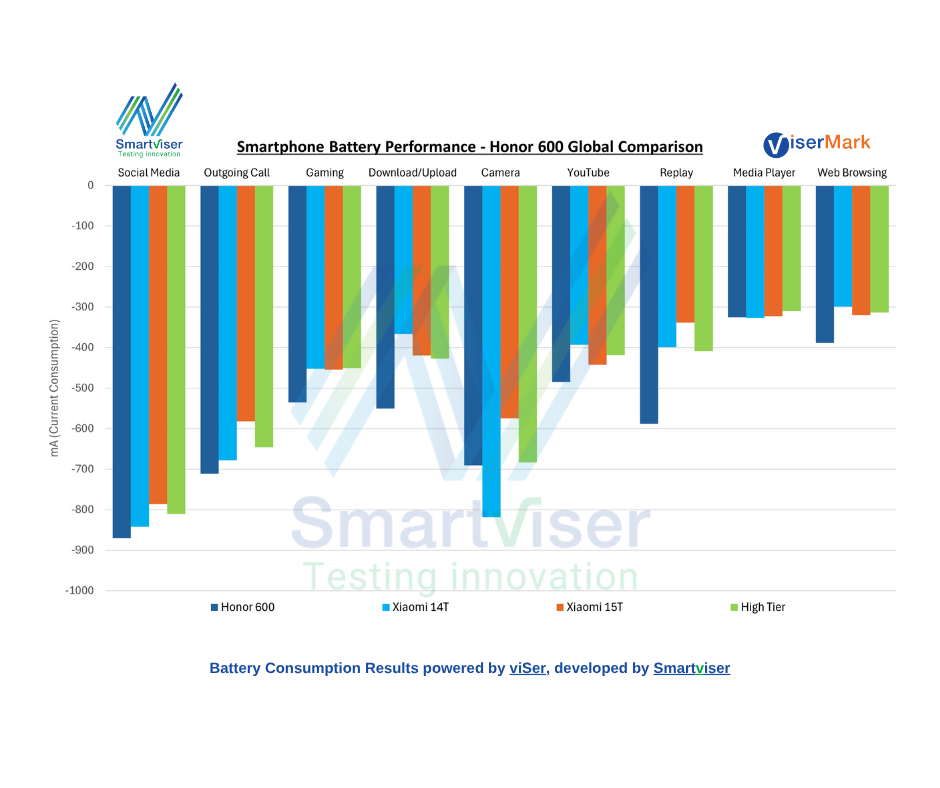
The Honor 600 delivers the strongest overall endurance, but it also records the highest power consumption across most tested workloads. During social media usage, outgoing calls, gaming, download/upload activity, YouTube streaming, replay, and web browsing, the Honor 600 consistently draws more power than both Xiaomi competitors and the high-tier segment average. The difference is particularly noticeable during replay workloads, where the Honor 600 consumes substantially more energy than both the Xiaomi 14T and Xiaomi 15T. This reflects a more demanding but endurance-focused power profile.
The Xiaomi 14T demonstrates a more efficiency-oriented approach in most everyday scenarios. It consumes significantly less power than the Honor 600 during gaming, downloads/uploads, YouTube streaming, replay, and web browsing, while also remaining below the high-tier segment average in several categories. However, camera usage is a major exception. During camera-related workloads, the Xiaomi 14T records the highest power consumption of all tested devices, drawing substantially more energy than both the Honor 600 and Xiaomi 15T. This suggests a particularly demanding imaging pipeline during extended photography and video recording sessions.
The Xiaomi 15T emerges as the most consistently efficient device overall. Across nearly every tested workload, including social media, calls, gaming, downloads/uploads, replay, media playback, and browsing, it records the lowest or near-lowest power consumption figures. It is especially efficient during replay workloads, where its consumption is dramatically lower than the Honor 600. Camera usage is also considerably better optimised than on the Xiaomi 14T, with the Xiaomi 15T drawing the least power during imaging tasks among the compared devices.
Compared with the high-tier reference average, both Xiaomi devices generally remain below or close to the segment norm, whereas the Honor 600 often exceeds it due to its more power-intensive behaviour. Nevertheless, the Honor 600 compensates with its significantly larger 6400mAh silicon-carbon battery, allowing it to achieve substantially longer real-world endurance despite its higher energy demand.
Overall, the results highlight two distinct philosophies within the high-tier segment. The Xiaomi 14T and Xiaomi 15T prioritise lower power draw and efficiency, while the Honor 600 focuses on delivering maximum runtime through a combination of aggressive battery capacity and sustained endurance.
In ViserMark’s battery efficiency evaluation, the Honor 600 achieved a 1-leaf rating, matching both the high-tier segment average and the Xiaomi 14T. The Xiaomi 15T, however, scored lower at 0.5 leaves, placing it below the category reference despite its generally lower power consumption during individual workloads.
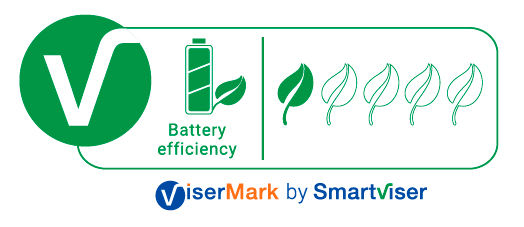
These results highlight an important distinction between raw power consumption and overall energy efficiency. While the Xiaomi 15T often consumes less power during day-to-day tasks, the Honor 600 compensates through its significantly larger 6400mAh silicon-carbon battery and longer sustained runtime. As a result, the Honor 600 achieves an efficiency rating in line with the broader high-tier segment despite its more power-intensive behaviour in several workloads.

The Honor 600’s 1-leaf rating reflects a balanced overall optimisation profile rather than exceptional low-power operation. Its energy consumption remains relatively high during demanding activities such as gaming, video replay, and prolonged screen-on usage, but the device maintains stable endurance without aggressive throttling or restrictive background management. This allows it to deliver excellent real-world battery life while remaining aligned with the efficiency standards of the high-tier category.
Overall, the Honor 600 demonstrates a solid and competitive energy efficiency profile for a high-tier smartphone, combining long runtime with stable optimisation and matching the segment benchmark for overall battery efficiency.
According to ViserMark’s annual energy consumption testing, the Honor 600 records an estimated yearly energy usage of 3.9 kWh, placing it slightly above the high-tier segment average of 3.79 kWh. While this means the device consumes somewhat more energy over time than the category reference, it still performs more efficiently than the Xiaomi 14T, which reaches 4.2 kWh annually.

Among the compared devices, the Xiaomi 14T records the highest annual energy consumption. This aligns with its particularly high power draw during camera-related workloads, where it consumes substantially more energy than both the Honor 600 and Xiaomi 15T. Although the Xiaomi 14T performs efficiently in several other tasks, its demanding imaging pipeline contributes noticeably to its higher long-term energy usage.

The Honor 600 sits between the two Xiaomi devices, balancing higher power consumption with exceptional runtime. Its slightly above-average annual consumption reflects its more demanding power profile during screen-intensive and media-heavy tasks. However, this increase remains relatively moderate considering the device’s large 6400mAh silicon-carbon battery and class-leading endurance performance.
Overall, the Honor 600 demonstrates a well-balanced energy profile for a high-tier smartphone. While it does not achieve the lowest annual energy consumption in this comparison, it maintains competitive long-term efficiency while delivering substantially longer battery life than its rivals.
Who Should Buy the Honor 600?
The Honor 600 is an excellent choice for users who prioritise battery life, long-term endurance, and everyday reliability over raw flagship-level performance. It is particularly well suited to people who want a modern high-tier smartphone capable of lasting significantly longer than many competitors under real-world usage conditions, while still offering a premium-feeling experience and strong overall versatility.
With its slim design, bright AMOLED display, and large 6400mAh silicon-carbon battery, the Honor 600 is especially appealing to users who spend long periods away from chargers or rely heavily on their phone throughout the day. Despite its high battery capacity, the device remains relatively lightweight and comfortable to handle, making it practical for prolonged daily use. Its extremely bright display also makes it well suited to outdoor usage and media consumption in challenging lighting conditions.
The Honor 600 stands out most clearly in endurance-focused scenarios. Users with mixed or media-heavy usage patterns, including social media, messaging, navigation, streaming, browsing, and photography, will benefit from its ability to sustain up to around two full days of real-world use. Even though SmartViser testing shows that the device consumes more power than several rivals during many individual workloads, its large battery capacity and stable optimisation allow it to deliver class-leading runtime within the high-tier segment.
Photography-focused users will also find the Honor 600 appealing. Its 200MP main camera with optical image stabilisation delivers detailed images with strong dynamic range and natural colour rendering, while the ultra-wide and macro capabilities provide additional flexibility for everyday photography. The phone is particularly well suited to users who regularly capture photos, social content, or video without needing a dedicated flagship camera system.
The Honor 600 is also a strong option for users planning to keep their smartphone for several years. Honor’s commitment to six years of Android and security updates places the device among the better-supported smartphones in its category, helping ensure long-term usability and software relevance.
However, the Honor 600 is less suited to users who prioritise maximum efficiency or flagship-grade processing power. While day-to-day performance remains smooth and responsive, the Snapdragon 7 Gen 4 does not compete with the highest-end chipsets for sustained gaming or intensive multitasking workloads. Likewise, users seeking premium materials such as aluminium frames or features like wireless charging may find the device slightly conservative compared with more expensive alternatives.
Ultimately, the Honor 600 is ideal for users who value endurance, practicality, and balanced real-world performance above benchmark-focused specifications. It combines exceptional battery life, fast charging, a high-quality display, capable cameras, and long software support into a highly dependable package, making it one of the most convincing high-tier smartphones for everyday long-term use.
ViserMark VERDICT
The Honor 600 - what's it like to use?
Using the Honor 600 feels reassuringly effortless in everyday life, with the device clearly designed around endurance, stability, and long-session comfort rather than short bursts of benchmark-focused performance. The overall experience is smooth and dependable, whether handling messaging, browsing, streaming, navigation, photography, or multitasking across several apps throughout the day. MagicOS remains fluid during normal use, and the phone rarely feels strained during typical real-world workloads.
A major part of this experience comes from the combination of the 6.55-inch AMOLED display and the device’s strong battery management. The screen feels vibrant and responsive, with smooth scrolling supported by the adaptive 120Hz refresh rate, while the extremely high peak brightness makes outdoor visibility particularly impressive. Whether using maps outdoors, watching video content, or simply scrolling through social media in bright sunlight, the Honor 600 remains comfortable and easy to read.
What becomes most noticeable over time is the phone’s endurance-focused character. The Honor 600 feels like a device designed to remove battery anxiety from everyday use. This creates a more relaxed day-to-day experience, especially for users who spend long periods away from chargers or rely heavily on their phone throughout the day.
The large silicon-carbon battery also changes how the phone feels psychologically in use. Users are less likely to monitor battery percentages or adjust habits around charging, because the device maintains a strong sense of reserve capacity even after extended use. Combined with 66W wired fast charging, short charging sessions are usually enough to restore substantial battery life, reinforcing the Honor 600’s practical and dependable nature.
Camera usage also feels confident and capable. The 200MP main sensor produces detailed and vibrant images quickly, and switching between photography, social sharing, and editing remains fluid. While the phone consumes more power than some rivals during demanding workloads such as video replay or prolonged screen-intensive use, this rarely becomes noticeable in practice because of the device’s large overall battery reserve.
That said, the Honor 600 is not positioned as a pure performance enthusiast device. Intensive gaming sessions and sustained heavy workloads reveal the limitations of the processor compared with other flagship-tier phones, and users focused primarily on maximum gaming performance may find more specialised alternatives better suited to their needs. MagicOS also retains its distinctive visual style and preinstalled software ecosystem, which may require some adjustment depending on user preference.
Despite these limitations, the Honor 600 succeeds in creating an experience that feels stable, practical, and highly dependable over extended daily use. Rather than chasing aggressive performance figures, it focuses on delivering consistency, comfort, long endurance, and smooth usability across the tasks that matter most to everyday users.
VCX (Valued Camera eXperience)
The VCX Forum has been working with its members on the system and infrastructure as a non-profit organisation. We strive to improve our technology to develop and exchange accurate and objective quality and performance indicators, which is our ultimate goal. We will also serve as a compass for the smartphone camera industry. We appreciate your interest in the VCX Forum.
VCX Forum: No review
Background
Established in 2013, HONOR is a leading global provider of smart devices, committed to becoming an iconic tech brand that enables a smart life for all people, across all scenarios and channels. With over 13,000 employees, more than 60% of whom are dedicated to research and development, HONOR focuses on innovation, quality, and service. The brand's extensive R&D capabilities and forward-looking technology empower people worldwide to achieve more. HONOR's impressive portfolio of innovative products and a vast retail presence with over 45,000 stores support more than 200 million active devices, creating a new intelligent world for everyone.
Written by

Marcella Frattari is the Communication Marketing and Lead Generation Manager at SmartViser, playing a key role in shaping the company's communication and marketing strategies. With a background in journalism and a passion for digital communication, Marcella focuses on improving SmartViser's overall online presence and engagement. Her dedication to clear, effective communication and creative content makes her a valuable asset to the team.
Press Contact
Marcella Frattari: Contact@visermark.com
Our Resources
ViserMark Scores | ViserMark Reviews | Success Stories | Latest Articles |
Discover what ViserMark is all about. | Read ViserMark's latest in-depth smartphone battery reviews. | Discover our main success stories with Telecoms and other industries. | Read more articles on our battery life, performance reviews, and test results. |


Comments