


Samsung Galaxy S26
SMARTPHONE TIER: FLAGSHIP/PRO TIER
Battery Capacity mAh: 4300
Samsung Galaxy S26: Optimisation Over Battery Size
SMARTPHONE BATTERY PERFORMANCE
Based on Price: Flagship/Pro Tier (€700+)
Flagship/Pro Tier Ranking #4

Learn more:
Video Review - Soon Available
The Samsung Galaxy S26 is a refined continuation of Samsung’s flagship philosophy, delivering a polished and well-balanced smartphone experience rather than chasing dramatic reinvention. It may not push boundaries in design or hardware, but it focuses on consistency, efficiency, and long-term usability, making it a compelling choice for users who value reliability over spectacle.
At its core sits the Snapdragon 8 Elite Gen 5, Qualcomm’s latest 3nm powerhouse, built around a high-performance Oryon V3 architecture. With two prime Phoenix L cores clocked up to 4.74GHz and six Phoenix M cores handling sustained workloads, the S26 delivers excellent responsiveness across all scenarios. Paired with the Adreno 840 GPU, 12GB of RAM, and up to 512GB of UFS 4.X storage, it handles demanding multitasking and high-end gaming with ease. Thermal management is solid for a device of this size, and while extended workloads can introduce mild throttling, everyday performance remains consistently smooth and reliable.
The 6.3-inch Dynamic LTPO AMOLED 2X display continues to be one of the device’s standout features. With a resolution of 1080x2340, a 120Hz adaptive refresh rate, and HDR10+ support, it delivers a fluid and vibrant viewing experience. Peak brightness reaches up to 2600 nits, ensuring excellent outdoor visibility, while deep blacks and rich colour reproduction maintain Samsung’s reputation for display quality. Protected by Gorilla Glass Victus 2, the panel strikes a balance between durability and visual performance.
Design-wise, the Galaxy S26 embraces subtle refinement over bold experimentation. At just 7.2mm thick and weighing 167g, it feels compact, lightweight, and comfortable in hand, increasingly rare qualities in the flagship space. The combination of glass panels and an Armour Aluminium frame gives it a premium, understated feel, while IP68 certification ensures durability against water and dust. Available in a range of finishes including Cobalt Violet, Sky Blue, and Silver Shadow, it maintains a clean, modern aesthetic without overstatement.
Photography remains consistent rather than groundbreaking. The triple camera system is led by a 50MP main sensor, supported by a 10MP telephoto lens with 3x optical zoom and a 12MP ultrawide. Image quality is dependable, with accurate colours, good dynamic range, and solid performance across varied lighting conditions. However, the lack of hardware upgrades compared to the previous generation may feel underwhelming for users expecting a significant leap. Video capabilities remain strong, with support for 8K recording and advanced stabilisation features such as Horizon Lock, while the 12MP front camera delivers sharp 4K video and reliable selfies.
Battery performance is where the Galaxy S26 quietly distinguishes itself. Despite a modest 4300mAh capacity, improvements in efficiency result in noticeably better real-world endurance. Power consumption is reduced compared to previous models, allowing the device to comfortably reach around two days of moderate use, or a full day under heavier workloads. This efficiency-first approach makes the S26 more consistent across a range of activities, from streaming and gaming to everyday browsing. However, charging speeds remain unchanged at 25W wired and 15W wireless, which feels conservative compared to many competitors offering significantly faster solutions.
The Galaxy S26 runs Android 16 with One UI 8.5, bringing a mature and feature-rich software experience. Samsung’s commitment to seven years of updates continues to be a major advantage, ensuring longevity and security well beyond most competitors. Features such as Samsung DeX, advanced AI tools, and seamless ecosystem integration enhance productivity and everyday usability.
With Wi-Fi 7, Bluetooth 5.4, stereo speakers, and an ultrasonic in-display fingerprint sensor, the Galaxy S26 covers all the essentials expected from a modern flagship. It may not be the most daring device in its category, but it excels in delivering a dependable, efficient, and well-rounded experience.
| Cons |
|
|
|
|
|
|
|
|
|
|
|
|
|
|
|
|
ViserMark Labels for the Samsung Galaxy S26
Please take a look at the following information about the battery performance of the Samsung Galaxy S26:

Battery Life: The Samsung Galaxy S26 delivers up to 48 hours of active use in testing, translating to roughly 1.5 to 2 days of moderate daily usage. While the 4300mAh battery may appear modest on paper, improved efficiency allows the device to outperform its predecessor and other comparable flagships in real-world scenarios. Users can expect reliable all-day endurance even with mixed usage, though intensive tasks such as prolonged gaming, camera use, or sustained high brightness will still reduce longevity and may require a recharge before the end of the day.
Battery Charging: The Galaxy S26 supports 25W wired charging and 15W wireless charging (Qi2 Ready), with Samsung claiming around 55% charge in 30 minutes. In practice, a full charge takes approximately 1 hour and 19 minutes using a compatible USB PD 3.0 charger, aligning closely with official expectations. Wireless charging remains noticeably slower and is influenced by thermal conditions and charging accessories. While these speeds are adequate for most users, they fall behind competitors that now offer significantly faster charging technologies, making this one of the device’s less competitive areas.
Battery Performance & Efficiency: Efficiency is where the Galaxy S26 makes its most meaningful progress. Annual energy consumption drops to approximately 2.9 kWh, a notable improvement over previous models. With a battery performance score of 47, the S26 stands out as a highly efficient flagship, prioritising consistency and sustained performance over raw battery capacity.
Specification Overview - Released Date: March 2026
Body & Build:
Dimensions: 149.6 x 71.7 x 7.2 mm
Weight: 167g
Materials: Armour Aluminium frame, Gorilla Glass Victus 2 front and back
Durability: IP68 certified, water and dust resistant (up to 1.5m for 30 minutes)
Design: Compact, lightweight, and premium with a clean, refined aesthetic
Display:
Size: 6.3-inch Dynamic LTPO AMOLED 2X
Resolution: 2340 x 1080 (FHD+), ~411 ppi
Refresh Rate: 120Hz adaptive
Brightness: Up to 2600 nits peak (advertised), ~1380 nits (measured)
HDR Support: HDR10+
Protection: Gorilla Glass Victus 2
Operating System:
OS: Android 16 with One UI 8.5
Support: Up to 7 years of OS and security updates
Chipset & Performance:
Processor: Snapdragon 8 Elite Gen 5 (3nm) / Exynos 2600 (region dependent)
CPU: Up to 2x 4.74 GHz + 6x 3.62 GHz (Oryon V3 architecture)
GPU: Adreno 840 / Xclipse 960 (region dependent)
Memory & Storage:
Configurations:
256GB + 12GB RAM
512GB + 12GB RAM
Expandable Storage: Not supported (no microSD)
Tech: UFS 4.X
Connectivity & Features:
5G: Yes (Sub6 + mmWave depending on region)
SIM: Dual SIM (Nano + eSIM, max 2 active lines)
Wi-Fi: Wi-Fi 7
Bluetooth: 5.4
NFC / USB-C: Yes / USB-C 3.2 (DisplayPort 1.2, OTG)
Biometrics: Ultrasonic in-display fingerprint reader
Samsung DeX: Supported (wired and wireless)
Audio: Stereo speakers
Camera System:
Rear Cameras:
50MP main (f/1.8, OIS, dual pixel PDAF)
10MP telephoto (f/2.4, 3x optical zoom, OIS)
12MP ultrawide (f/2.2, 120°, Super Steady video)
Front Camera: 12MP (f/2.2, Dual Pixel PDAF)
Video: Up to 8K (rear), 4K60 (front), HDR10+, 10-bit video
Colours Available: Cobalt Violet, Sky Blue, Black, White, Silver Shadow, Pink Gold
Performance - HOW WE TEST
ViserMark offers a comprehensive range of battery performance test results based on different criteria and benchmarks for evaluating a smartphone's performance. Our tests are performed using the strictest protocol in a controlled environment to ensure repetition and consistency powered by SmartViser's test automation solution viSer.

VWS Analytics Studio is a complementary product to the viSer Test Automation solution. It enhances the viSer user experience and is the fastest way to analyse and view smartphone test results.
We have used the interactive dashboard to show you the recent test results and translated them into ViserMark Labels.
Join our readers to receive the latest update to our smartphone battery performance scores and performance reviews as soon as we finish testing!

Smartphone Battery Performance - FULL TEST RESULTS AND REVIEW
ViserMark has put the Samsung Galaxy S26 through our testing protocol, based on real smartphone usage from 100% battery level down to power off. This includes daily activities, such as calls, web, video and music streaming, gaming, social networks, picture and video capture, and standby. All activities are executed in a defined order and timeline.
These test results, show how the Samsung Galaxy S26 performed and the scores achieved.
1. Battery Performance
The Samsung Galaxy S26 achieved a battery performance score of 47/100 in ViserMark testing, placing it clearly ahead of the Galaxy S25 and S25 Edge (both at 41/100) as well as the Flagship/Pro Tier average (~41.9/100). This improvement reflects Samsung’s focus on efficiency rather than simply increasing battery capacity, allowing the S26 to deliver more consistent endurance across a range of real-world usage scenarios.

Charging is handled via 25W wired power delivery, with Samsung advertising a 55% top-up in 30 minutes. In our real-world testing, the device reached a full charge in 1 hour and 19 minutes using a certified USB PD charger. Wireless charging is supported at 15W (Qi2 Ready), alongside reverse wireless charging at 4.5W. While functional, charging speeds remain conservative compared to competitors offering significantly faster solutions.

Overall, the Galaxy S26 positions itself as an efficiency-driven flagship rather than a battery brute. It delivers dependable, well-optimised performance that comfortably supports all-day usage and beyond, without the need for excessive battery capacity. Users prioritising consistency and optimisation will appreciate this approach, while those seeking ultra-fast charging or maximum endurance may still find stronger alternatives elsewhere.
2. Battery Life
In ViserMark’s battery life testing, the Samsung Galaxy S26 achieved 48 hours of continuous usage, translating to around 1.5 days of real-world battery life under typical conditions. This marks a clear improvement over the Galaxy S25 (35 hours) and S25 Edge (34 hours), despite the S26 maintaining a relatively compact form factor and a modest 4300mAh battery.

Thanks to the Snapdragon 8 Elite Gen 5 chipset and Samsung’s One UI 8.5 optimisations, the S26 demonstrates excellent efficiency across a range of workloads. While it slightly trails the Flagship/Pro Tier average (~40.7 hours) in peak endurance scenarios, it delivers more consistent performance across mixed usage, particularly in everyday tasks such as browsing, streaming, and social media.


Overall, the Galaxy S26 provides dependable day-to-day stamina with a strong emphasis on efficiency rather than raw battery size. It comfortably supports full-day use and beyond for most users, making it a well-balanced choice for those seeking reliability without compromising on performance or portability.
The Samsung Galaxy S26 and Samsung Galaxy S25 were analysed for battery consumption across various daily tasks using SmartViser's viSer and VWS Analytics Studio. The comparison highlighted differences in power usage for activities such as social media, calls, gaming, camera, and web browsing.
As the direct successor to the Galaxy S25, the Galaxy S26 demonstrates significantly lower power consumption in several key areas. The most notable gains appear in social media, outgoing calls, and download/upload tasks, where the S26 draws considerably less power than the S25. This indicates improved optimisation in connectivity, data handling, and background processing.
The advantage continues in media playback scenarios, where the S26 maintains lower consumption, further reinforcing its efficiency gains in sustained but optimised workloads.
However, the picture is more nuanced in other scenarios. In gaming, the S26 consumes slightly more power than the S25, suggesting that higher performance levels come with a small efficiency trade-off under sustained GPU load. This trend becomes more pronounced in the Replay workload, where the S26 draws noticeably more power, indicating that background-heavy or repeated processing tasks are less efficiently handled compared to the S25.
A similar pattern appears in YouTube streaming, where the S26 also consumes more power than the S25. This suggests that video streaming workloads are not as optimised as other use cases, potentially due to higher processing demands or differences in display and decoding behaviour.
Camera usage shows relatively similar results between both devices, with only marginal differences in consumption. Web browsing is also closely matched, though the S26 retains a slight efficiency edge overall.

In conclusion, the Galaxy S26 represents a meaningful step forward in overall energy efficiency, delivering lower power consumption across most everyday tasks, particularly those involving connectivity and data transfer, while still showing some trade-offs in more demanding or sustained workloads such as gaming, replay, and video streaming.
The Samsung Galaxy S26 and Galaxy S25 Edge show clear differences in power consumption across key usage scenarios, reflecting two distinct optimisation strategies despite sharing the same flagship tier positioning.

The Galaxy S26 demonstrates significantly lower power consumption in several core tasks. The most substantial gains appear in social media, outgoing calls, and download/upload activities. These are major efficiency improvements, indicating better optimisation in connectivity, modem usage, and sustained data handling. Web browsing and media playback also favour the S26, further reinforcing its advantage in everyday usage scenarios.
However, the S26 does not outperform the S25 Edge across all workloads. In gaming, the S26 consumes more power, suggesting a higher performance output but with a corresponding efficiency trade-off. This pattern continues in YouTube streaming, where the S26 shows notably higher consumption, likely due to differences in display behaviour or video processing.
The Replay workload further highlights this trade-off, with the S26 drawing slightly less power, indicating better handling of certain background or repeated processing tasks compared to the Edge. Camera usage remains broadly similar between both devices, with only marginal differences that are unlikely to impact real-world usage significantly.
In conclusion, the Galaxy S26 delivers a more efficient and balanced power profile overall, particularly in connectivity-driven and everyday tasks. However, these gains come with trade-offs in performance-heavy and video-related workloads, where the S25 Edge can be more efficient. This positions the S26 as the more optimised all-rounder, while the Edge retains advantages in specific high-intensity scenarios.
The battery performance comparison between the Samsung Galaxy S26, Galaxy S25, S25 Edge, and the Flagship/Pro Tier average reveals clear differences in energy consumption across everyday activities, offering a comprehensive view of how each device manages power under real-world conditions.

The Galaxy S26 emerges as the most efficient device in connectivity-driven scenarios. It significantly outperforms both the S25 and S25 Edge in social media, outgoing calls, and download/upload tasks. It also slightly outperforms the Flagship/Pro Tier average in these areas, highlighting strong optimisation in modem efficiency and background data handling.
The S26 also performs well in media playback, where it is more efficient than both the S25 and S25 Edge, as well as the category average. Web browsing results are closely aligned with the average, indicating balanced efficiency in lighter workloads.
However, the S26 does not lead across all scenarios. In gaming, it consumes more power than both the S25 and S25 Edge, and also exceeds the Flagship/Pro Tier average, suggesting a higher performance output with a corresponding efficiency cost. A similar pattern appears in YouTube streaming, where the S26 is significantly less efficient than both competitors and the average. The Replay workload further reinforces this trend, with the S26 drawing considerably more power than the S25 and the category average, though slightly outperforming the S25 Edge.
Camera usage presents a more balanced picture. While the S26 is slightly less efficient than the S25, it remains more efficient than both the S25 Edge and significantly better than the Flagship/Pro Tier average, indicating strong optimisation in imaging workloads.
In conclusion, the Galaxy S26 delivers the most well-rounded and efficient power profile overall, particularly in everyday and connectivity-heavy scenarios. However, these gains come with clear trade-offs in video streaming, replay, and gaming workloads. This highlights a strategic shift towards real-world efficiency, rather than peak optimisation across all use cases.
In ViserMark’s battery efficiency testing, the Samsung Galaxy S26 achieved a 1.5-leaf rating, placing it clearly ahead of both the Galaxy S25 and S25 Edge (1 leaf each), as well as the Flagship/Pro Tier average (1.0). This result highlights a meaningful leap in energy efficiency within Samsung’s flagship lineup.

Despite maintaining a relatively compact design and a modest 4300mAh battery, the S26 benefits from improved optimisation across both hardware and software. The combination of the Snapdragon 8 Elite Gen 5 chipset and One UI 8.5 enables more efficient power management, particularly in connectivity-driven and everyday usage scenarios.
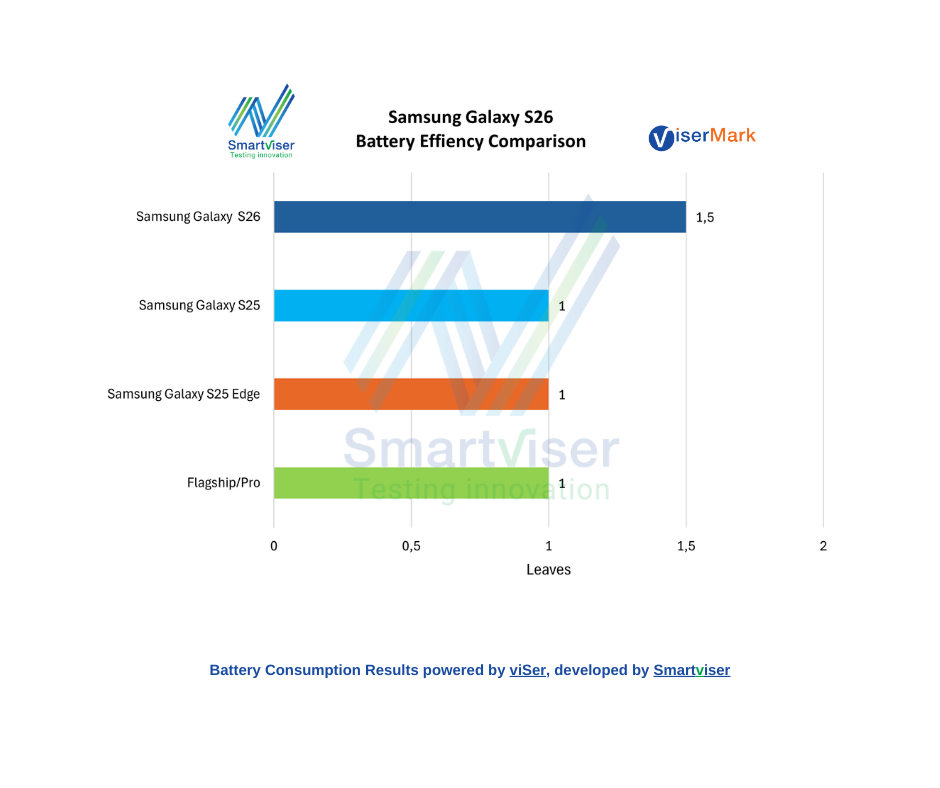
Unlike its predecessor, the S26 demonstrates more consistent efficiency across a wider range of workloads, including social media, calls, and data-intensive tasks. These gains suggest enhanced modem efficiency, better background process control, and more refined system-level optimisation.
The 1.5-leaf rating confirms that the Galaxy S26 not only meets flagship efficiency standards but surpasses them, positioning it among the most energy-efficient devices in its category. For users prioritising longevity, consistency, and optimisation over raw battery capacity, the S26 represents a significant step forward in Samsung’s approach to power efficiency.
According to ViserMark, the Samsung Galaxy S26 has an estimated annual energy consumption of 2.9 kWh, representing a significant improvement over both the Galaxy S25 and S25 Edge (3.7 kWh), as well as the Flagship/Pro Tier average (3.7 kWh). This positions the S26 among the most energy-efficient devices in the premium segment.

This reduction in energy consumption highlights Samsung’s shift towards optimisation-driven efficiency. Despite delivering flagship-level performance and maintaining a high-end display and feature set, the S26 manages to draw considerably less power over time, resulting in lower long-term energy usage.

Compared to its predecessor, the improvement is substantial, reflecting better integration between the Snapdragon 8 Elite Gen 5 chipset and One UI 8.5. Gains in connectivity, background processing, and overall system efficiency contribute to this lower consumption profile across a wide range of daily tasks.
In practical terms, the Galaxy S26 offers meaningful energy savings without compromising performance. It demonstrates that high-end smartphones can deliver both power and efficiency, making it an excellent choice for users seeking a premium experience with reduced long-term energy impact.
Who Should Buy the Samsung Galaxy S26?
The Galaxy S26 is ideal for users who prioritise a well-balanced flagship experience, combining strong performance, compact design, and excellent energy efficiency. Its lightweight form factor, premium build, and vibrant AMOLED display make it particularly appealing to those who want a high-end smartphone that remains comfortable for everyday use.
Battery efficiency is one of its standout strengths. Despite its relatively modest 4300mAh capacity, the S26 delivers excellent real-world endurance, outperforming its predecessor and the flagship category average in overall battery life and annual energy consumption. It excels in connectivity-driven tasks such as social media, calls, and data usage, making it especially suitable for users with active, on-the-go usage patterns.
The device is also well suited for users who value longevity and software support. With seven years of updates, alongside features like Samsung DeX and a mature One UI experience, the S26 offers strong long-term usability and ecosystem integration. Professionals, frequent travellers, and everyday users alike will benefit from its consistent performance and reliability.
However, it may be less ideal for users who prioritise peak performance in sustained workloads such as intensive gaming or prolonged video streaming, where power consumption is higher compared to some competitors. Similarly, those seeking cutting-edge camera innovation or ultra-fast charging may find better options elsewhere.
Ultimately, the Galaxy S26 is best suited for users who want a refined, efficient, and dependable flagship, one that delivers a premium experience without excess bulk or unnecessary complexity.
ViserMark VERDICT
The Samsung Galaxy S26 - what's it like to use?
Using the Galaxy S26 feels like a refined, well-balanced flagship that prioritises consistency over flashiness. The Snapdragon 8 Elite Gen 5 and 12GB of RAM deliver fast, fluid performance across multitasking, gaming, and everyday apps, with a level of stability that makes the experience feel polished and reliable. One UI 8.5 runs smoothly, with AI features subtly enhancing productivity and usability without overwhelming the core experience.
The 6.3-inch AMOLED display is sharp, responsive, and easy on the eyes, making everything from scrolling to streaming feel effortless. Its compact size and lightweight design make the S26 particularly comfortable to use one-handed, while still maintaining a premium feel thanks to its glass and aluminium build.
Battery performance is one of the standout aspects in daily use. The S26 feels efficient and dependable, easily lasting through a full day and often beyond with moderate usage. It performs especially well in everyday tasks like social media, browsing, and connectivity-heavy scenarios, where optimisation is clearly noticeable. Charging speeds remain modest, but they are consistent and predictable.
Overall, the Galaxy S26 offers a smooth, dependable user experience that focuses on refinement and efficiency. It may not be the most exciting flagship on paper, but in everyday use, it proves to be one of the most reliable and well-rounded devices in its class.
VCX (Valued Camera eXperience)
The VCX Forum has been working with its members on the system and infrastructure as a non-profit organisation. We strive to improve our technology to develop and exchange accurate and objective quality and performance indicators, which is our ultimate goal. We will also serve as a compass for the smartphone camera industry. We appreciate your interest in the VCX Forum.
VCX Forum: No review
Background
The Samsung Group is a South Korean multinational conglomerate headquartered in Samsung Town, Seoul. It comprises numerous affiliated businesses, most united under the Samsung brand. Samsung Electronics has assembly plants and sales networks in 74 countries and employs around 290,000 people. Samsung is a major manufacturer of electronic components such as lithium-ion batteries, semiconductors, image sensors, camera modules and displays for clients such as Apple, Sony, HTC and Nokia.
Written by

Marcella Frattari is the Communication Marketing and Lead Generation Manager at SmartViser, playing a key role in shaping the company's communication and marketing strategies. With a background in journalism and a passion for digital communication, Marcella focuses on improving SmartViser's overall online presence and engagement. Her dedication to clear, effective communication and creative content makes her a valuable asset to the team.
Press Contact
Marcella Frattari: Contact@visermark.com
Our Resources
ViserMark Scores | ViserMark Reviews | Success Stories | Latest Articles |
Discover what ViserMark is all about. | Read ViserMark's latest in-depth smartphone battery reviews. | Discover our main success stories with Telecoms and other industries. | Read more articles on our battery life, performance reviews, and test results. |


Comments